
Chemical periodic table
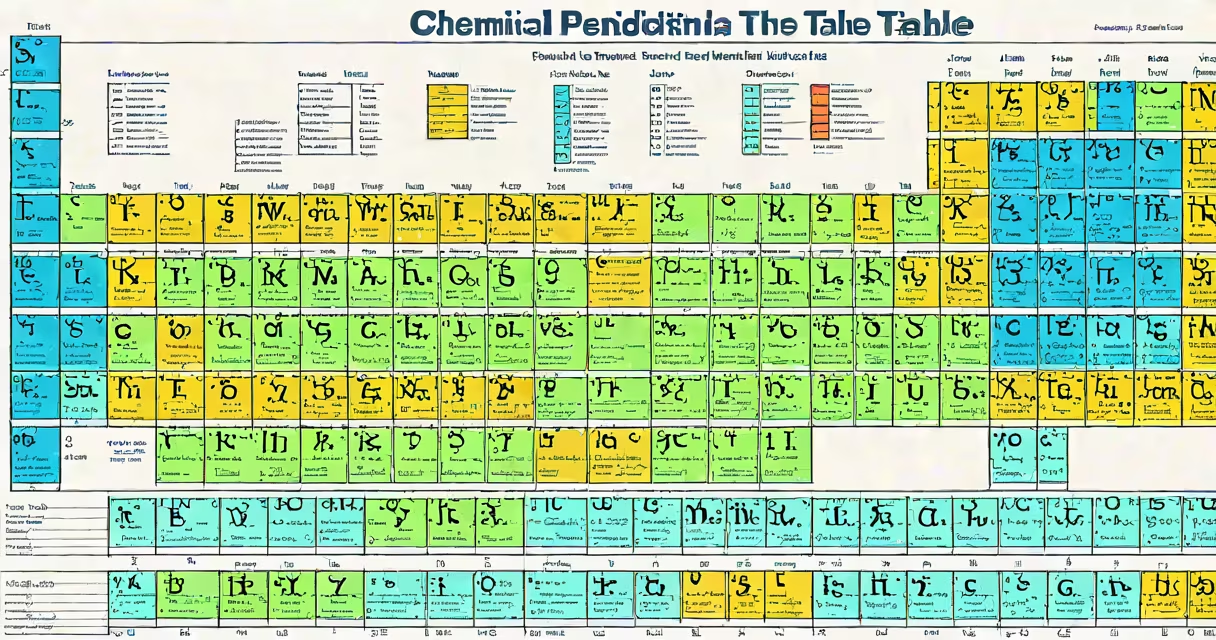
The chemical periodic table is a systematic arrangement of all known chemical elements ordered by increasing atomic number, electron configuration, and recurring chemical properties. It groups elements into rows (periods) and columns (groups) based on shared characteristics such as valence electrons and reactivity. This layout enables rapid prediction of element behavior and discovery of new elements.
Elements appear in order of rising atomic number-the number of protons in the nucleus. The table's structure reflects electron shell filling: each period begins with an alkali metal and ends with a noble gas. Groups share similar outer-shell electron counts, leading to comparable chemical behaviors. For example, Group 1 (alkali metals) all form +1 ions and react vigorously with water.
Developed by Dmitri Mendeleev in 1869, the modern version includes 118 confirmed elements. The International Union of Pure and Applied Chemistry (IUPAC) maintains official naming and symbol standards. Elements beyond uranium (atomic number 92) are synthetic and typically unstable, decaying within seconds or minutes.
How the chemical periodic table works
Each element occupies a cell defined by its atomic number, symbol, name, and average atomic mass. Cells are arranged in seven horizontal periods and 18 vertical groups. The placement determines physical and chemical traits. For instance, elements in Group 17 (halogens) have seven valence electrons and readily gain one electron to form -1 ions.
Periods represent energy levels. As you move left to right across a period, atomic radius decreases due to increasing nuclear charge pulling electrons closer. Ionization energy increases because removing an electron becomes harder with greater effective nuclear charge. These trends allow chemists to predict bond formation and reaction outcomes.
Transition metals (Groups 3-12) fill inner d-orbitals, resulting in multiple oxidation states and catalytic activity. Iron, nickel, and copper exhibit variable charges and form colored compounds-key traits in biological systems and industrial processes.
Types and categories of elements
The table divides elements into four broad categories: metals, metalloids, nonmetals, and noble gases. Metals dominate the left and center, showing high conductivity, malleability, and tendency to lose electrons. Nonmetals occupy the upper right, including oxygen, nitrogen, and sulfur-elements essential to life and atmospheric chemistry.
| Category | Location | Properties | Examples |
|---|---|---|---|
| Metal | Left and center | Shiny, conductive, ductile, lose electrons | Copper, iron, aluminum |
| Nonmetal | Upper right | Dull, poor conductor, gain electrons | Oxygen, carbon, chlorine |
| Metalloid | Border between metals and nonmetals | Intermediate properties, semiconductors | Silicon, arsenic, antimony |
| Noble gas | Far right, Group 18 | Colorless, odorless, inert | Neon, argon, xenon |
Some elements exist in multiple forms called allotropes. Carbon appears as graphite, diamond, and fullerenes-each with distinct physical properties despite identical composition. This variation underscores how atomic arrangement influences macroscopic behavior.
Common misconceptions and clarifications
The chemical periodic table is not arbitrary-it reflects quantum mechanical principles governing electron orbitals. The placement of lanthanides and actinides below the main table is a space-saving convention, not a deviation from structure. These series belong in Period 6 and 7, respectively, between barium and hafnium, and radium and rutherfordium.
A frequent error is assuming all elements in a group behave identically. While fluorine and chlorine both form diatomic molecules and react with metals, fluorine is far more reactive due to lower bond dissociation energy and higher electronegativity. Fluorine attacks glass; chlorine does not.
Another myth: that the periodic table is complete. New elements are synthesized in particle accelerators. Nihonium (element 113), moscovium (115), tennessine (117), and oganesson (118) were added after 2016. Their half-lives are measured in milliseconds, making experimental study extremely limited.
Practical applications and real-world use
Chemists use the chemical periodic table to design materials, predict reaction pathways, and develop pharmaceuticals. In drug discovery, understanding the position of elements like nitrogen, oxygen, and halogens helps model molecular stability and bioavailability. For example, replacing hydrogen with fluorine in a compound often improves metabolic stability-a key factor in long-acting medications.
In materials science, titanium (Group 4) is valued for its strength-to-weight ratio and corrosion resistance. Its placement near vanadium and chromium explains why it forms stable alloys with these metals. This insight guided the development of aerospace-grade titanium alloys used in jet engines.
I once designed a catalyst using palladium (Pd, atomic number 46) and gold nanoparticles. By referencing the periodic table, I predicted Pd's ability to adsorb hydrogen and help bond cleavage. The resulting catalyst reduced reaction time by 60% compared to pure palladium-proof that elemental positioning predicts functional behavior.
Related tools and further exploration
Understanding the chemical periodic table is foundational to chemistry, physics, and engineering. It remains a living tool-updated as new elements are discovered and our grasp of atomic interactions deepens.