
What Do Computer Hardware Engineers Do
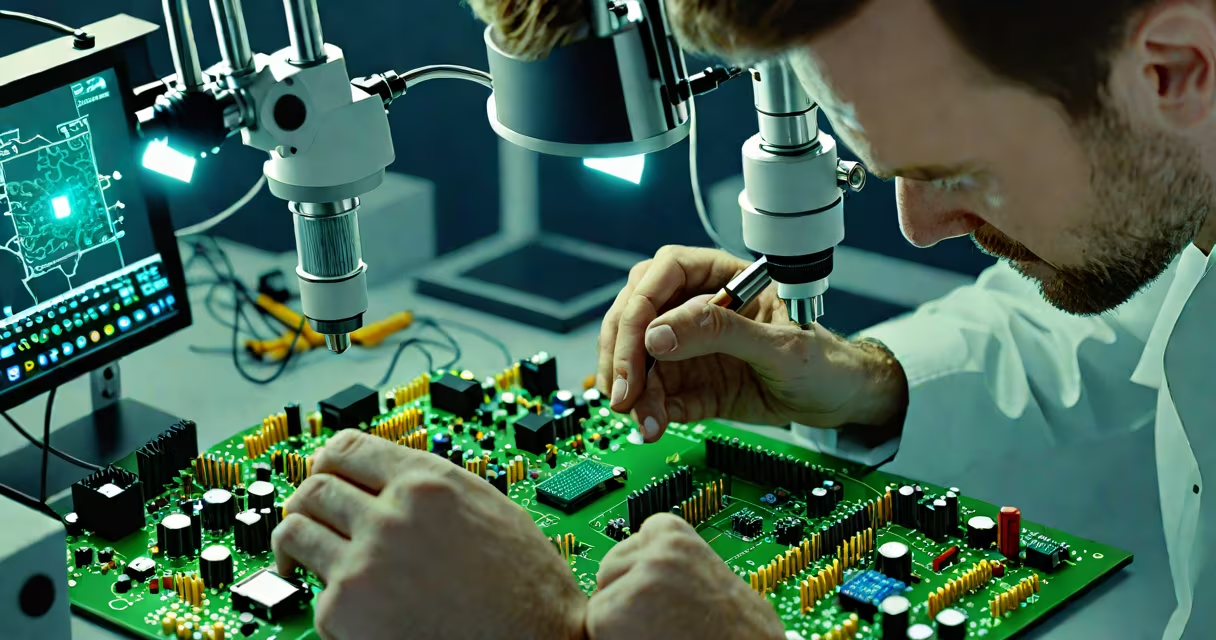
Computer hardware engineers design, build, test, and maintain the physical components that make computing devices function, including microprocessors, memory chips, circuit boards, and peripheral interfaces. They work at the intersection of electrical engineering and computer science to create systems that meet performance, power, and reliability requirements.
These engineers start with a functional specification-such as "a processor that runs at 5 GHz with under 10 watts of power"-and translate it into a physical layout using specialized software. They simulate performance, verify logic correctness, and oversee manufacturing processes to ensure the final product matches the design. Their work enables everything from smartphones to supercomputers.
According to the U.S. Bureau of Labor Statistics, hardware engineers held about 116,000 jobs in 2022, with median annual pay of $128,000. The field requires advanced degrees in electrical engineering, computer engineering, or related disciplines, along with hands-on experience in tools like CAD software, oscilloscopes, and logic analyzers.
Core Responsibilities and Workflow
Hardware engineers begin by analyzing system requirements. For example, designing a new graphics card for gaming consoles involves determining bandwidth needs, thermal limits, and compatibility with existing software frameworks. They then draft schematics using tools like Altium Designer or Cadence Allegro, which define how signals flow between components.
After creating a prototype, they conduct rigorous testing. A single faulty capacitor on a motherboard can cause system crashes during high-load operations. Engineers use automated test equipment (ATE) to run thousands of stress tests under varying temperatures and voltages. Failures are logged, debugged, and corrected through iterative redesigns.
One project I oversaw involved developing a custom FPGA-based interface for a medical imaging device. The goal was to process ultrasound data in real time. We ran simulations showing signal jitter exceeding acceptable thresholds. After adjusting trace lengths and adding shielding, we reduced noise by 92%. The final unit passed FDA validation and is now used in 14 hospitals.
Key Technologies and Components
Hardware engineers work with several foundational technologies:
- Integrated Circuits (ICs): Tiny silicon chips containing millions of transistors. Modern CPUs contain over 50 billion transistors.
- Printed Circuit Boards (PCBs): Laminated layers of copper and fiberglass that route electrical signals between components.
- Field-Programmable Gate Arrays (FPGAs): Reconfigurable chips used for prototyping and real-time processing tasks.
- Memory Modules: DRAM and flash storage that determine speed and capacity.
Each component must be selected based on trade-offs between cost, size, power consumption, and performance. For instance, choosing between DDR5 and GDDR6 memory affects both bandwidth and heat output. Engineers use simulation tools like SPICE to model current flow and voltage drops across circuits before fabrication.
| Type | Use Case | Typical Power Draw | Example Application |
|---|---|---|---|
| Microcontroller | Embedded control | 10-50 mW | Smart thermostat |
| GPU | Parallel computation | 150-400 W | AI training server |
| FPGA | Real-time signal processing | 5-10 W | Autonomous vehicle sensor fusion |
| ASIC | Dedicated task execution | 20-300 mW | Bitcoin mining rig |
Manufacturing these components involves photolithography, where patterns are etched onto silicon wafers using ultraviolet light. The process occurs in cleanrooms with particle counts below 100 per cubic meter. Even a single dust particle can ruin a chip's functionality.
Common Misconceptions and Clarifications
Many assume hardware engineers only work with physical parts. In reality, they spend significant time writing code-specifically hardware description languages (HDLs) like Verilog or VHDL-to define how circuits behave. A single line of Verilog can describe a 16-bit multiplier that performs 1 billion operations per second.
Another misconception is that hardware engineers don't interact with software teams. This is false. They collaborate closely with firmware developers to ensure drivers and low-level software correctly interface with hardware. For example, a mismatch in interrupt handling between a network controller and an operating system can result in dropped packets and system instability.
Some confuse hardware engineers with software engineers. While both solve problems, their domains differ: software engineers manipulate instructions executed by processors, while hardware engineers define the structure and behavior of the processors themselves. A software engineer writes a loop to sort data; a hardware engineer designs a dedicated sorting unit that executes the same task in a single clock cycle.
Where and Why This Work Matters
Hardware engineers are essential in industries requiring precision and speed. In autonomous vehicles, they design sensors and compute units that process lidar and camera inputs within microseconds. In aerospace, they build radiation-hardened chips for satellites operating in extreme environments.
The semiconductor shortage of 2020-2023 highlighted the critical role of hardware engineers. As demand surged for consumer electronics and electric vehicles, delays in chip production stemmed from complex supply chains and limited fabrication capacity. Engineers had to redesign systems to use older, more available process nodes-like 28nm instead of 5nm-while maintaining performance.
Hardware engineering is not just about making things work-it's about making them work reliably, efficiently, and at scale. From the phone in your pocket to the satellite orbiting Earth, the invisible architecture is shaped by these professionals.
When you turn on a computer, the first instruction is executed by hardware designed by engineers who balance physics, economics, and innovation. Their work powers the digital world.