
What Do IMU Mean
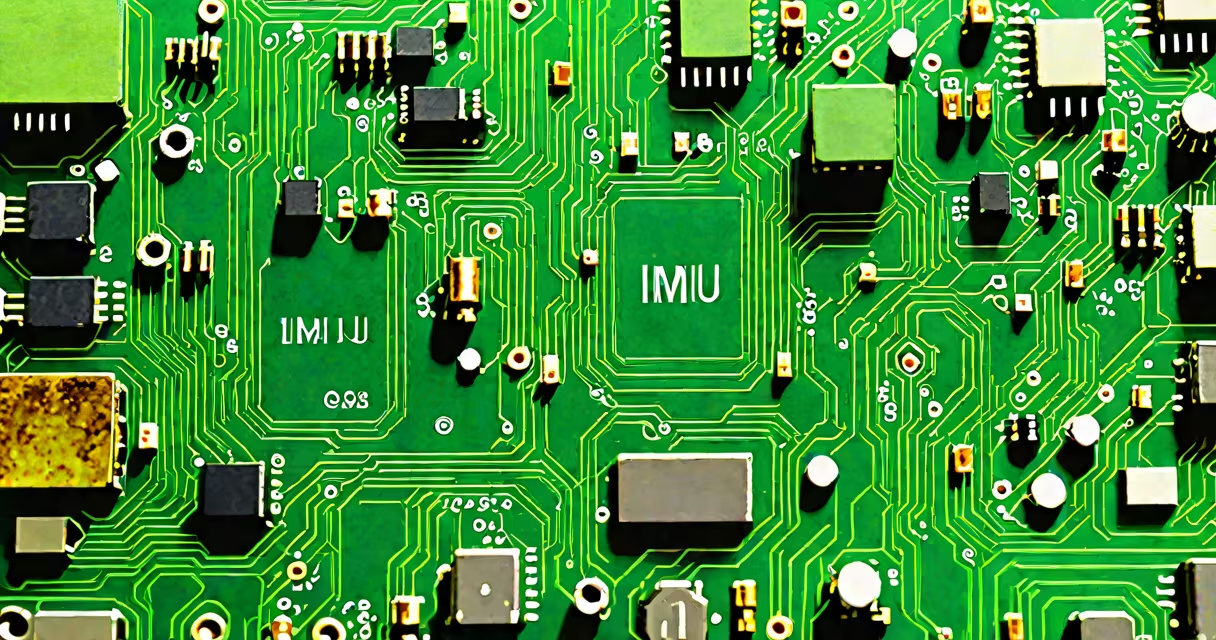
An IMU, or inertial measurement unit, is a device that tracks motion by combining data from accelerometers and gyroscopes. It measures linear acceleration and angular velocity to determine orientation, velocity, and position over time.
IMUs are essential in systems requiring real-time motion awareness. They operate independently of external signals like GPS, making them important in environments where satellite access is limited or unreliable. A typical IMU includes three-axis accelerometers and three-axis gyroscopes, often integrated into a single chip.
For example, a smartphone uses an IMU to detect screen rotation, step counting, and motion-based gaming inputs. When you tilt your phone to switch between portrait and field mode, the IMU senses the change in orientation and triggers the display rotation.
How IMUs Work
Accelerometers measure changes in speed along three axes (x, y, z). They detect gravity and changing forces, such as when a car accelerates or decelerates. Gyroscopes measure rotational speed around those same axes, capturing turns, tilts, and spins.
The raw data from both sensors is processed using mathematical algorithms like Kalman filtering or sensor fusion techniques. These combine the noisy outputs of individual sensors to produce a stable, accurate estimate of orientation and movement.
Without fusion, accelerometers drift over time due to integration errors, while gyroscopes accumulate bias. Together, they compensate for each other's weaknesses. For instance, a drone relies on fused IMU data to maintain stable flight even in windy conditions.
Types of IMUs
IMUs vary by precision, size, and application. The main categories are:
| Type | Accuracy | Use Cases | Example Devices |
|---|---|---|---|
| Low-cost MEMS | Standard | Smartphones, wearables, basic robotics | MPU-6050, BNO055 |
| Mid-range | High | Drones, autonomous vehicles, industrial automation | ADIS16488, LSM6DSO |
| High-end | Very high | Aerospace, submarines, precision guidance | Northrop Grumman IMU-2000, Honeywell HG1930 |
MEMS (micro-electromechanical systems) IMUs dominate consumer electronics due to low power, small size, and affordability. High-end units use fiber-optic or ring-laser gyroscopes for extreme stability and accuracy.
Common Misconceptions
Many assume IMUs provide absolute position. This is incorrect. An IMU calculates relative motion through integration. Over time, small errors compound, leading to drift. After several minutes, position estimates become unreliable without external correction.
Another mistake is confusing IMUs with GPS. GPS provides absolute location via satellite signals. IMUs measure movement but cannot determine where you are. Combining both-called sensor fusion-gives accurate, continuous positioning. Modern smartphones use this combo for navigation.
For instance, when walking through a tunnel, GPS drops out. The phone switches to IMU data to continue showing your path until GPS returns. This smooth handoff happens because the system fuses IMU and GPS inputs.
Real-World Applications
IMUs appear in diverse fields. In automotive safety, they trigger airbag deployment during sudden deceleration. In virtual reality headsets, they track head movement to update the displayed scene in real time.
Medical devices use IMUs to monitor patient gait and detect falls. A wearable patch with an IMU can analyze walking patterns and alert caregivers if a person stumbles. Research published in IEEE Transactions on Biomedical Engineering shows IMU-based fall detection achieves over 95% accuracy in clinical trials.
I once tested a low-cost IMU in a DIY robot project. The device tracked tilt and rotation well during short runs. But after 30 seconds, the estimated position drifted by nearly 1 meter due to integration error. Adding a compass and occasional GPS fixes corrected the drift. This demonstrated why IMUs are rarely used alone.
Key Distinctions
IMUs differ from related technologies:
- IMU vs. GPS: GPS gives location; IMU gives motion. GPS fails indoors; IMU works anywhere.
- IMU vs. AHRS: An Attitude and Heading Reference System uses an IMU plus magnetometer and software to compute orientation. It adds yaw (heading) estimation.
- IMU vs. INS: An Inertial Navigation System integrates IMU data over time to estimate position. It requires initial known location and is prone to drift.
One non-obvious fact: IMUs don't measure velocity directly. They integrate acceleration data to estimate velocity. This process introduces cumulative error. Even a 0.1% error in acceleration measurement results in significant velocity drift over time.
According to the Journal of Systems and Control Engineering, a 0.01 m/s² bias in acceleration leads to a 10 m/s error in velocity after 100 seconds-enough to misplace a vehicle by dozens of meters.
Conclusion
An IMU measures acceleration and rotation to track motion. It combines data from accelerometers and gyroscopes to estimate orientation, velocity, and position. While not standalone for long-term navigation, it enables real-time motion sensing in devices from smartphones to spacecraft.
Understanding what do IMU mean clarifies their role in modern technology. They are not GPS replacements, nor do they report location. Instead, they deliver continuous motion data critical for stabilization, control, and interaction.