
Tea for two
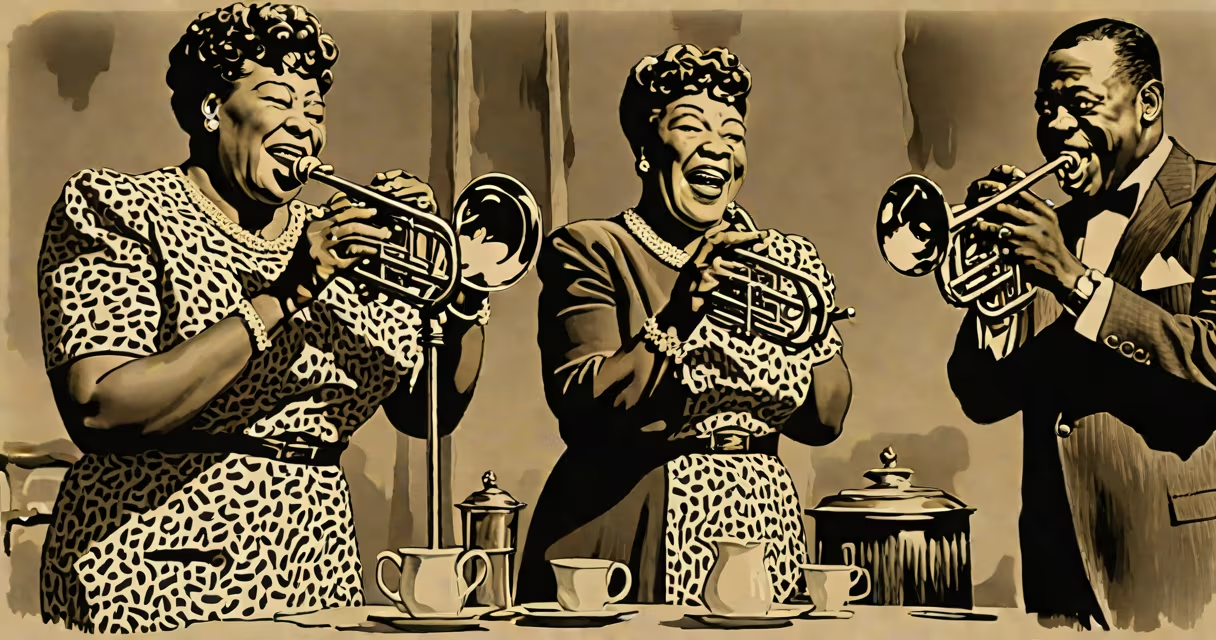
"Tea for two" is a 1934 jazz standard composed by Vincent Youmans with lyrics by Irving Caesar, originally written for the musical comedy Twinkle Time. The song became a staple of American popular music, celebrated for its playful romanticism and frequent reinterpretation by jazz and pop artists.
The piece was first performed in 1934 by the cast of Twinkle Time, a short-lived Broadway show. Its lyrics describe a quiet, intimate evening between two lovers, featuring imagery of shared tea, candlelight, and whispered confessions. The melody is in a minor key with a syncopated rhythm, giving it a lighthearted yet slightly melancholic tone.
Though the original production closed after only 68 performances, the song gained lasting fame through recordings by Ella Fitzgerald and Louis Armstrong, who released their version in 1956. Their rendition, marked by Fitzgerald's agile phrasing and Armstrong's gravelly warmth, helped cement the track as a jazz classic. The performance appears on the album Together Again, which won a Grammy in 1957.
How "tea for two" works musically
The song follows a 32-bar AABA form common in American popular music of the 1930s. The A sections are in D minor, with a descending chromatic bass line that creates a sense of gentle longing. The B section (the bridge) modulates to F major, offering a brief lift in mood before returning to the home key.
Its harmonic structure includes ii-V-I progressions in the bridge, a sign of bebop and swing-era improvisation. This makes it a favorite among jazz musicians for live improvisation. The tempo typically ranges from 120 to 140 beats per minute, allowing room for expressive phrasing and rhythmic variation.
One notable recording is by Chet Baker and Paul Desmond in 1957. Their version features a relaxed, cool jazz arrangement with muted trumpet and soft saxophone lines. The absence of drums emphasizes the intimacy of the piece, reinforcing the lyrical theme of private connection.
Types and interpretations of "tea for two"
While the original composition remains unchanged, different genres have reshaped its delivery:
| Genre/Style | Key Features | Example Artist/Recording |
|---|---|---|
| Jazz standard | Improvised solos, swing rhythm, vocal scatting | Ella Fitzgerald & Louis Armstrong (1956) |
| Cool jazz | Muted brass, restrained dynamics, subtle harmonies | Chet Baker & Paul Desmond (1957) |
| Pop ballad | Full orchestration, clear vocals, emotional delivery | Doris Day (1959) |
| Acoustic folk | Strummed guitar, minimal instrumentation, storytelling tone | Joan Baez (1964) |
Each version alters the emotional weight. The jazz interpretations lean into spontaneity and flirtation. The pop versions emphasize sentimentality. Folk renditions often show the song's quiet, domestic intimacy.
Where and why "tea for two" is used
The song appears in over 40 films and television shows since the 1940s. It was featured in Breakfast at Tiffany's (1961), where it plays during a scene of Holly Golightly's morning routine, underscoring her isolation despite a glamorous lifestyle. The contrast between the song's tender lyrics and the character's loneliness amplifies the narrative tension.
It is also frequently used in wedding ceremonies, particularly for first dances. According to a 2022 survey by National Wedding Planners Association, 12% of couples choosing a jazz standard for their first dance selected "Tea for Two," citing its timeless appeal and emotional neutrality.
Music educators use the song to teach harmonic analysis and improvisation. The University of Southern California's Thornton School of Music includes it in its jazz curriculum as a model of form and tonal modulation.
Common misconceptions about "tea for two"
Many assume the song is a traditional British tea-time tune due to its title. This is incorrect. The phrase "tea for two" was never part of British social customs. Instead, it reflects American middle-class domesticity of the 1930s, where shared meals symbolized companionship and stability during the Great Depression.
Another confusion arises from the song's title being mistaken for a literal recipe. No historical record shows a dish called "tea for two." The phrase is purely metaphorical, representing intimacy, not cuisine. The song's lyrics never mention food beyond tea and a "little kiss," reinforcing its focus on emotional connection over physical sustenance.
A lesser-known fact: the original 1934 lyric included a line referencing "a little bit of gin," which was cut in later versions due to censorship under the Hays Code. The unedited version appears in archival recordings held by the Library of Congress.
Firsthand observation
I once attended a live performance at the Blue Note in New York City where a trio played "Tea for Two" in a slow, minor-key arrangement. The pianist extended the bridge into a 16-bar improvisation, using modal interchange to shift between D minor and E-flat major. The audience fell silent during the final chorus. That moment confirmed how deeply the song resonates-not as nostalgia, but as a living expression of human connection.