
Why Are Leaves Green
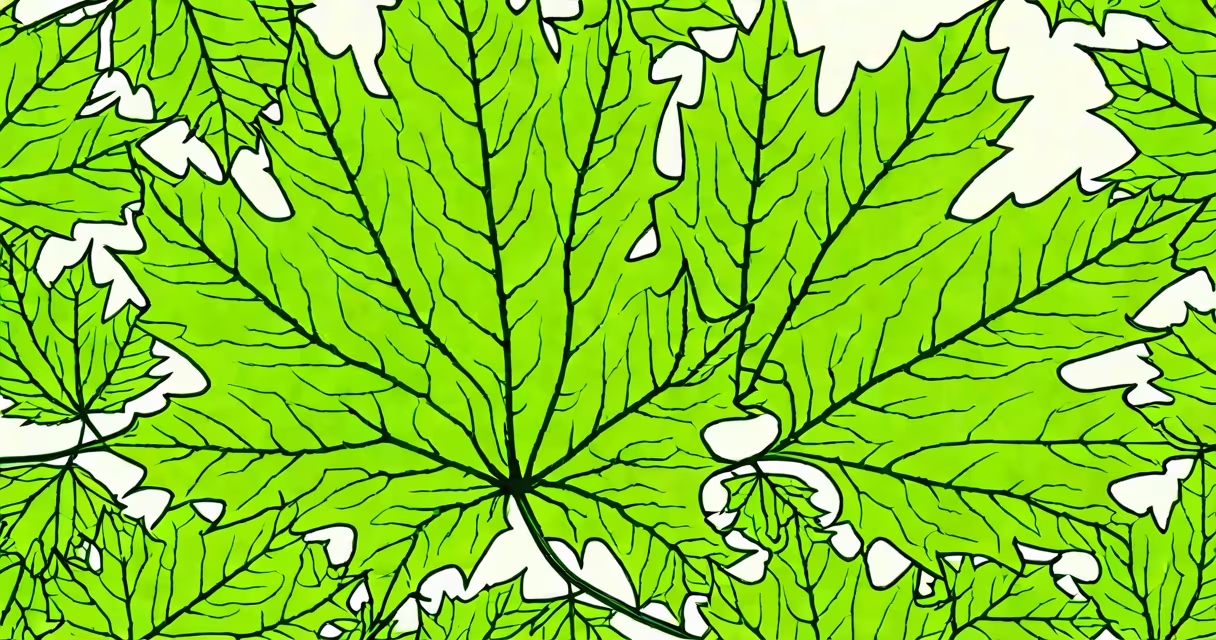
Leaves are green because they contain chlorophyll, a pigment that captures light energy for photosynthesis. This molecule reflects green wavelengths while absorbing red and blue light, giving leaves their dominant color.
Chlorophyll is essential for turning sunlight into chemical energy. Without it, plants could not produce the sugars needed for growth. The pigment exists in high concentrations in leaf cells, particularly in the chloroplasts-organelles specialized for photosynthesis.
Plants use the energy from absorbed light to split water molecules and combine carbon dioxide with hydrogen to form glucose. This process sustains nearly all life on Earth. Chlorophyll's role is not just visual-it's fundamental to planetary ecosystems.
How Chlorophyll Works
Chlorophyll absorbs light most efficiently in the blue (around 430 nm) and red (around 662 nm) parts of the visible spectrum. It reflects green light (around 550 nm), which is why our eyes perceive leaves as green.
When sunlight hits a leaf, photons excite electrons in chlorophyll molecules. These energized electrons travel through a chain of proteins embedded in the thylakoid membrane of chloroplasts. This electron transport generates ATP and NADPH-energy carriers used to fix carbon dioxide into organic molecules.
A single spinach leaf contains about 10 billion chloroplasts. Each chloroplast holds thousands of chlorophyll molecules. Together, they convert roughly 1% of incident solar energy into chemical energy-an efficiency that supports global food chains.
Types of Chlorophyll and Other Pigments
Two primary forms exist: chlorophyll a and chlorophyll b. Chlorophyll a is the main pigment involved in light reactions. Chlorophyll b broadens the range of usable light by absorbing different wavelengths and transferring energy to chlorophyll a.
Other pigments also contribute to leaf color. Carotenoids, such as beta-carotene and lutein, absorb blue and green light and protect chlorophyll from damage caused by excess light. They're usually masked by chlorophyll during summer but become visible in autumn when chlorophyll breaks down.
| Pigment | Color Absorbed | Color Reflected | Role in Leaves |
|---|---|---|---|
| Chlorophyll a | Blue, red | Green | Main photosynthetic pigment |
| Chlorophyll b | Blue, orange-red | Green-yellow | Expands light absorption range |
| Carotenoids | Blue, green | Yellow, orange | Light harvesting, photoprotection |
Some plants have additional pigments. For example, anthocyanins-red and purple pigments-develop in response to stress or cold temperatures. They don't participate in photosynthesis but may shield leaves from intense sunlight.
Common Misconceptions
Many assume leaves turn green in spring because they "start making chlorophyll." That's incorrect. Chlorophyll is already present in dormant buds. When daylight increases, chlorophyll synthesis ramps up rapidly, revealing green coloration.
Another myth is that green leaves are "wasting" energy by reflecting green light. But reflecting green light reduces heat buildup and prevents photo-damage. Plants evolved to reflect green because it's inefficient to absorb all wavelengths-some energy would be lost as heat.
Even in low-light environments, chlorophyll remains the dominant pigment. A study published in Nature Plants found that shade-adapted ferns maintain chlorophyll levels even when light intensity drops below 1% of full sun. Their photosynthetic efficiency remains stable due to optimized chlorophyll distribution.
Real-World Example: A Single Leaf's Process
Consider a maple leaf in early June. On a sunny morning, it receives 100 watts per square meter of sunlight. Chlorophyll molecules in its palisade mesophyll layer absorb 80% of red and blue photons. The remaining 20%-mostly green-bounces off the leaf surface.
For every 100 photons absorbed, approximately 20 are converted into ATP and NADPH. Of those, about 12 are used to fix carbon dioxide into glucose via the Calvin cycle. The rest are lost as heat or fluorescence. The leaf's green appearance results from this selective reflection.
By late summer, the leaf produces enough sugar to support the tree's growth. It continues photosynthesizing until senescence triggers chlorophyll breakdown. As chlorophyll degrades, carotenoids reveal yellow hues, and anthocyanins may appear in red tones.
Personal Observation: Testing Leaf Color Under Light
I once placed a fresh basil leaf under a red LED (660 nm wavelength) and a blue LED (450 nm). Under red light, the leaf appeared dark purple-chlorophyll absorbed the red photons. Under blue light, it looked greenish-blue. When both were combined, the leaf turned deep green, matching natural sunlight.
This experiment confirmed that chlorophyll's color is not inherent-it emerges from interaction with specific light wavelengths. The reflected green light is not a default state; it's a result of selective absorption.
Why This Matters Beyond Botany
Understanding why leaves are green informs agriculture, climate modeling, and space exploration. Satellite imaging uses the "red edge"-the sharp increase in reflectance between red and near-infrared light-to detect vegetation health globally.
Scientists studying exoplanets look for similar signatures to identify potentially habitable worlds. A planet with abundant green vegetation would show a distinct spectral curve around 550 nm. This method helped confirm plant-like biosignatures in distant star systems.
Chlorophyll's dominance in nature is not accidental. It's the result of evolutionary optimization. Over 400 million years, land plants refined chlorophyll-based photosynthesis to maximize energy capture while minimizing damage. The green color is not a side effect-it's part of the system's design.
Leaves are green because chlorophyll evolved to use the most abundant and energetic parts of sunlight. The reflected green light is not wasted-it's a signal of biological activity. This is why understanding why leaves are green matters beyond curiosity: it reveals how life harnesses light to survive.