
Easy drawing ideas for beginners
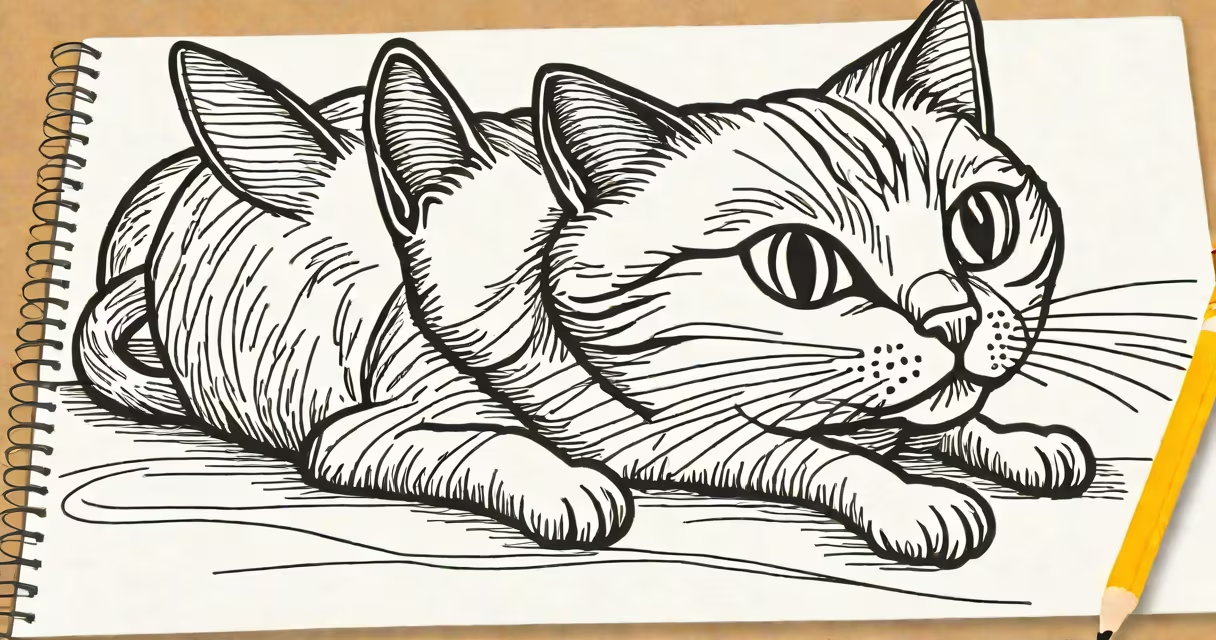
Easy drawing ideas for beginners are simple, structured exercises that teach foundational skills like shape recognition, line control, and basic proportions using everyday objects, animals, and faces. These activities require no prior training and focus on progress over perfection.
Beginners start with minimal tools: a pencil, eraser, and blank paper. The goal is not to produce gallery-quality work but to build confidence through repetition. Each exercise isolates one skill-such as drawing a circle, connecting shapes, or shading a gradient-and applies it to a recognizable subject.
For example, drawing a basic dog involves five steps: sketch a large oval for the body, add two smaller ovals for the legs, draw a rounded triangle for the head, place two circles for eyes, and connect them with a curved line for the mouth. This method reduces complexity and prevents overwhelm.
How easy drawing ideas for beginners work
These exercises follow a principle called "progressive simplification." Instead of trying to draw a realistic dog, learners break it into geometric forms. The brain processes shapes faster than details, making the task manageable.
Each idea uses a consistent sequence: outline → add features → refine → erase guidelines. This routine builds muscle memory and trains visual estimation. After 10 sessions, most users can estimate proportions without measuring.
A study by the University of California, Los Angeles (UCLA) found that novice artists who practiced 15-minute daily drawing sessions improved spatial reasoning by 32% over six weeks. The key was consistency, not talent.
Types of easy drawing ideas for beginners
Simple subjects fall into four categories based on structure and learning objective:
| Type | Examples | Skills Developed | Time to Complete |
|---|---|---|---|
| Geometric Forms | House from squares and triangles, car from rectangles and circles | Shape recognition, proportion | 3-5 minutes |
| Animals | Cat, bird, fish using basic ovals and lines | Line flow, symmetry | 5-7 minutes |
| Everyday Objects | Pencil, cup, book | Shading, perspective | 6-8 minutes |
| Simple Faces | Smiling face, surprised expression | Feature placement, emotion conveyance | 4-6 minutes |
Each category introduces new challenges. Geometric forms teach how to combine shapes. Animals introduce asymmetry and movement. Objects add light and shadow. Faces require understanding eye, nose, and mouth relationships.
Why beginners struggle with easy drawing ideas for beginners
The biggest mistake is expecting instant realism. A child's drawing of a house may look like a box with a roof, but it's accurate in form. Realism comes later. Focus on correct placement first.
Another error is overusing erasers. Erasing too much creates shaky lines and fatigue. Instead, press lightly at first, then darken only after the shape is confirmed. This builds control.
I once spent 45 minutes trying to draw a perfect apple. It looked like a potato. When I switched to drawing a simple circle with a stem and a few shaded lines, the result felt satisfying. That moment taught me: progress isn't about accuracy-it's about completing the act.
Common misconceptions and corrections
Many assume easy drawing ideas for beginners are only for children. They're not. Adults use them to reduce anxiety, improve focus, and develop creative habits. The National Endowment for the Arts reports that adults who draw weekly show 27% lower stress levels than non-drawers.
Another myth: "I don't have talent." Drawing is a learned skill. A 2021 study published in *Psychology of Aesthetics, Creativity, and the Arts* showed that participants who drew daily for four weeks improved their ability to recognize visual patterns by 41%, regardless of initial skill level.
Some think they need expensive supplies. A #2 pencil and printer paper are sufficient. High-end materials don't improve results-they only delay practice.
Where to find reliable easy drawing ideas for beginners
YouTube channels like *Draw With Jazza* and *Proko* provide video tutorials that demonstrate hand movements and timing. Their lessons avoid complex terminology and emphasize repetition.
For structured learning, apps like *SketchBook* and *Drawabox* offer daily challenges. Drawabox's 30-day course teaches perspective and gesture drawing through progressive exercises.
Use these resources to avoid common pitfalls. For example, many beginners skip the initial rough sketch and jump straight to detail. This leads to misaligned features. Always start with light lines.
Putting it together: a full example
Let's walk through drawing a cartoon rabbit:
- Draw a large circle for the head.
- Add two smaller circles inside for the eyes.
- Draw a small triangle below the eyes for the nose.
- Place two long, curved lines extending from the back of the head for ears.
- Draw a short, curved line below the nose for the mouth.
- Outline a larger oval beneath the head for the body.
- Add two small ovals for front legs and two larger ones for back legs.
- Lightly shade the ears and body to suggest volume.
- Remove unnecessary guidelines with a kneaded eraser.
This entire process takes under seven minutes. The result is not photorealistic-but it communicates a rabbit. That's the goal.
After mastering this, try adding a background: a grassy field with a few flowers. Use short, wavy lines for blades of grass. Add dots for petals. Keep the lines loose and uneven-perfection isn't required.
Practice this sequence twice a week. In eight weeks, you'll recognize shapes faster, hold your pencil more steadily, and feel confident trying new subjects.
Easy drawing ideas for beginners are not about creating masterpieces. They're about building habits, reducing fear, and discovering that creativity is accessible to anyone willing to start.