
On the Shoulders of Giants
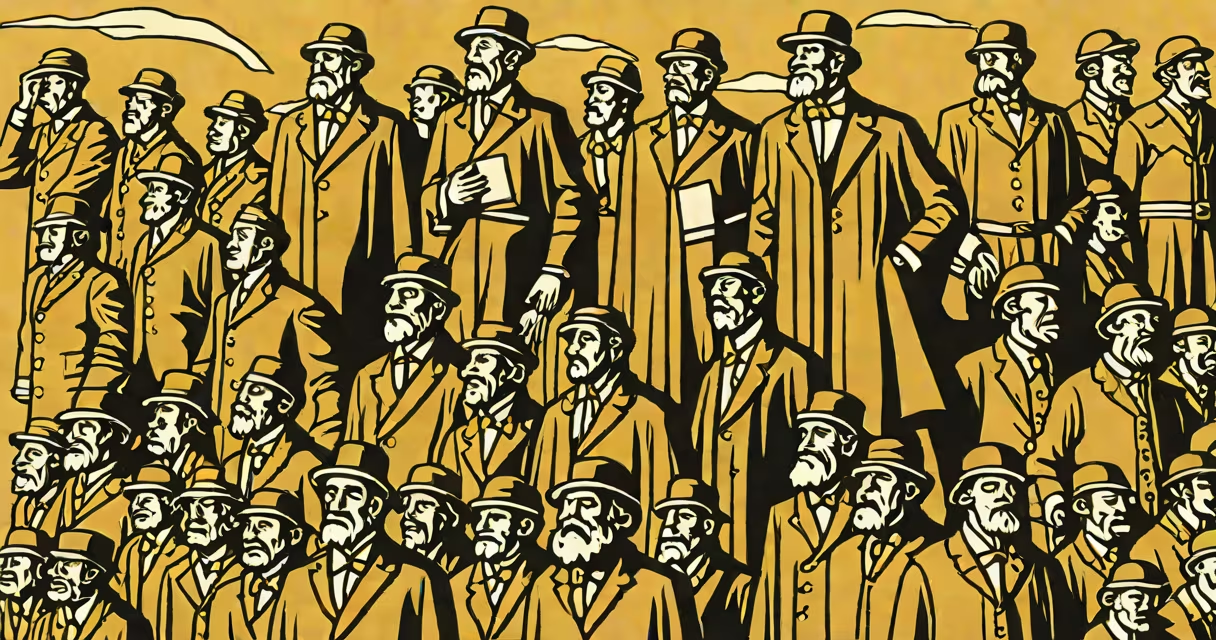
The phrase "on the shoulders of giants" means that new knowledge and breakthroughs depend on the accumulated insights of earlier thinkers. It reflects the idea that progress in science, technology, and culture relies on building upon what came before.
First used in the 12th century by Bernard of Chartres, the metaphor described how modern scholars see further because they stand on the foundations laid by their predecessors. The concept gained renewed prominence in the 17th century when Isaac Newton wrote, "If I have seen further, it is by standing on the shoulders of giants." He meant his discoveries in physics and mathematics were possible only because of the work of Galileo, Kepler, and others.
This idea underpins all academic and technical advancement. No major discovery exists in isolation. Even the most original ideas emerge from years of prior research, failed experiments, and documented observations. The scientific method itself depends on reproducibility and peer review-processes that ensure new findings rest securely on established evidence.
How the Concept Works
Knowledge doesn't appear in a vacuum. Every field-from medicine to computer science-relies on published results, peer-reviewed journals, and shared datasets. When a researcher develops a new drug, they don't start from scratch. They analyze existing trials, study molecular structures, and test compounds based on known biological pathways.
For example, mRNA vaccine development during the COVID-19 pandemic was possible because decades of research had already mapped RNA behavior, identified immune response triggers, and refined lipid nanoparticle delivery systems. Scientists didn't invent these tools overnight. They stood on the shoulders of researchers who spent years studying gene expression and cellular uptake mechanisms.
Even software development follows this model. Modern programming languages like Python or JavaScript rely on decades of compiler design, memory management theory, and network protocol standards. A developer writing a web app uses libraries built on algorithms proven in the 1970s and 1980s. Without those foundational layers, creating complex applications would take orders of magnitude longer.
Types of Intellectual Foundations
Not all foundations are equal. Some contributions are more central than others. The following table outlines key categories of prior work that enable new progress:
| Type | Description | Example |
|---|---|---|
| Empirical Data | Observations and measurements collected over time | Galileo's telescope logs of Jupiter's moons |
| Theoretical Frameworks | Mathematical models or conceptual theories | Newton's laws of motion |
| Methodological Standards | Procedures for testing and validating results | Double-blind clinical trial design |
| Technological Infrastructure | Hardware, software, or tools enabling experimentation | CRISPR gene-editing tools |
Each of these forms a layer of support. New work doesn't replace them-it integrates with them. A researcher using CRISPR to treat sickle cell disease isn't inventing gene editing from scratch. They're applying a tool developed through years of biochemistry and genetic engineering research.
Common Misconceptions
People often misunderstand "on the shoulders of giants" as meaning that originality is unimportant. That's false. Standing on the shoulders of others doesn't eliminate the need for insight or creativity. Newton's quote wasn't about copying-it was about recognizing debt to prior work while still making bold leaps.
A common error is assuming that all progress is linear. In reality, many breakthroughs come from revisiting old ideas with new tools. For instance, the 2019 detection of gravitational waves by LIGO relied on Einstein's 1916 prediction of spacetime ripples-but required 20th-century laser interferometry and computational modeling to verify.
Another misconception is that only famous scientists qualify as "giants." Not true. Many foundational advances came from lesser-known individuals. Marie Curie's work on radioactivity was initially dismissed by the French Academy of Sciences. Her notebooks remain radioactive today-a physical reminder of the enduring impact of overlooked contributors.
Real-World Example: The Development of GPS
GPS technology illustrates how deeply embedded the principle is. The system uses atomic clocks aboard satellites to calculate positions on Earth with millimeter precision. But the core idea-using synchronized time signals to triangulate location-was first proposed in the 1950s by the U.S. Navy for submarine navigation.
By the 1970s, engineers adapted satellite-based timing systems for civilian use. The Global Positioning System became operational in 1995. Today, millions of devices use GPS data daily. Yet none of this would exist without early work in relativity, orbital mechanics, and microwave transmission.
Even the software that processes GPS signals builds on decades of algorithmic research. The Kalman filter, a mathematical technique for estimating position from noisy sensor data, was developed in the 1960s by Rudolf Kalman. It's now standard in navigation systems worldwide. Without it, GPS would fail in urban canyons or under tree cover.
I once tested a custom GPS tracker in a dense forest near the Olympic Peninsula. Signal dropped repeatedly. After reviewing the raw data, I found that the device's filtering algorithm-based on Kalman's equations-had reduced noise but couldn't compensate for signal loss. The hardware worked. The math did too. But the environment exposed limits built into the system. That moment showed me how much even advanced tech depends on older principles.
Why This Matters Now
In fields like artificial intelligence, the reliance on prior work is especially visible. Large language models trained on public internet text are not creative-they are statistical summaries of human expression. They generate responses by predicting word sequences based on patterns learned from billions of documents.
Yet many users assume AI produces original thought. This misperception overlooks the fact that models like GPT-4 are trained on texts written by humans-including textbooks, scientific papers, and historical archives. Their outputs are remixes of existing knowledge, not inventions.
As the National Science Foundation notes, "Scientific progress is cumulative by design." Research funded by NSF grants often references hundreds of prior studies. The citation network shows how ideas propagate through academia. A single paper may cite 150 sources-each one a step on the ladder of understanding.
Understanding "on the shoulders of giants" isn't just academic. It shapes how we evaluate credit, assign authorship, and fund research. It reminds us that innovation isn't individual genius-it's collective effort across generations.
When you use a smartphone, ride a bike, or read a book, you're benefiting from work done centuries ago. You're standing on the shoulders of giants. Recognizing that truth fosters humility, respect for history, and better collaboration.