
What Is EXW
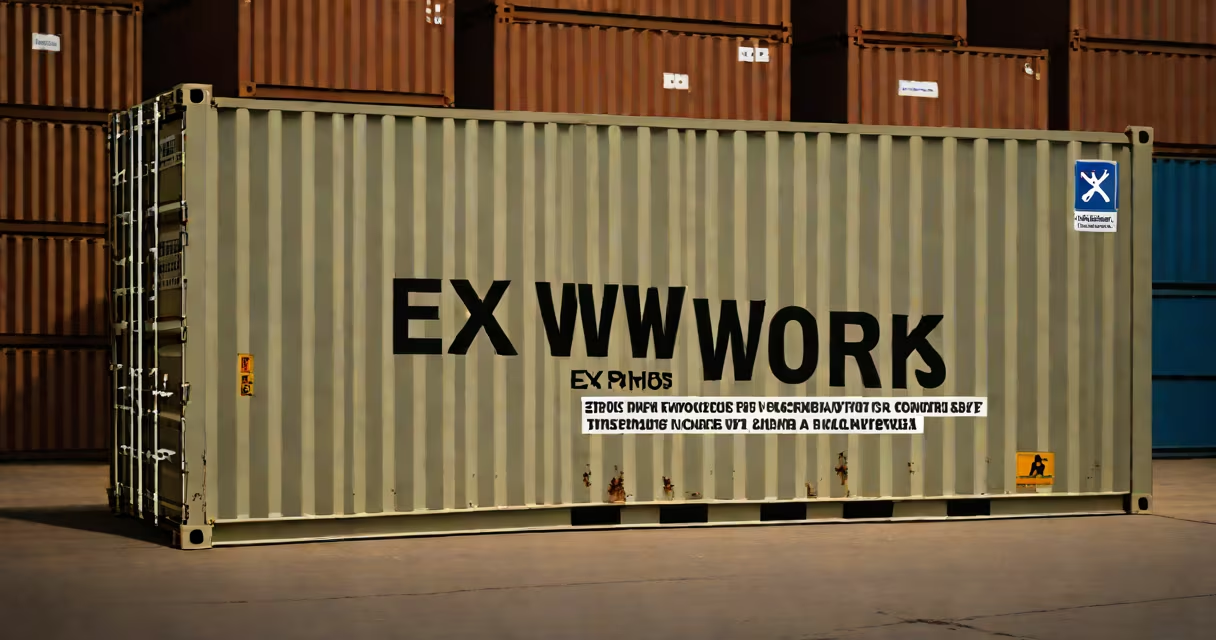
EXW, or Ex Works, is an Incoterm that places full responsibility for transportation, customs clearance, and risk on the buyer from the moment goods are made available at the seller's premises. The seller's obligation ends when the goods are ready for pickup.
EXW is the simplest and most seller-friendly term in the Incoterms® set. It requires minimal effort from the seller - typically just preparing the goods and notifying the buyer they're ready. All logistics, insurance, export documentation, and freight costs fall to the buyer.
For example, if a manufacturer in Shenzhen produces 100 units of a product and agrees to sell under EXW terms, the buyer must arrange pickup from the factory gate. The buyer pays for loading, export paperwork, freight, customs duties, and unloading at the destination port. The seller has no further obligations.
How EXW Works in Practice
Under EXW, the seller delivers goods to a specified location - usually their own facility - and notifies the buyer. The buyer then takes over all responsibilities. This includes arranging transport, securing export licenses, handling customs declarations, and managing freight insurance.
The buyer bears all risk from the moment the goods are loaded onto the buyer's vehicle at the seller's site. If damage occurs during transit, the buyer is liable. Even if the goods are lost or seized at customs, the buyer bears the cost unless covered by insurance.
Because the seller has no involvement beyond making goods available, EXW is often used when the buyer has established logistics networks, local agents, or expertise in cross-border shipping. It's common in B2B transactions where buyers handle global supply chains internally.
Types and Variants of EXW
EXW has no sub-types. Unlike FOB or CIF, which define specific points of transfer (e.g., at port or on board ship), EXW applies universally: the transfer happens at the seller's premises. There is no variation based on mode of transport or location.
However, the location matters. EXW can be applied to any agreed-upon place - a warehouse, factory, or even a retail store. The contract must specify the exact address. Ambiguity leads to disputes. For example, "EXW Shanghai" without specifying the warehouse or factory name creates risk.
| Term | Buyer Responsibility Starts | Cost Burden | Risk Transfer Point |
|---|---|---|---|
| EXW | At seller's premises | Full freight, customs, insurance | When goods are loaded onto buyer's transport |
| FOB | Onboard vessel at port | Freight from port onward | When goods cross the ship's rail |
| CIF | Onboard vessel at port | Freight and insurance to destination | Same as FOB, but seller arranges insurance |
Common Confusions and Misconceptions
Many buyers assume EXW means the seller handles export clearance. That's incorrect. Under EXW, the buyer must obtain export licenses and file the necessary documentation. The seller may refuse to provide documents unless explicitly required by law.
Another misconception is that EXW is always cheaper. While the quoted price may be lower because the seller doesn't cover logistics, the total cost can exceed other terms if the buyer lacks efficient shipping channels. A buyer without freight-forwarding experience may pay more in customs delays, incorrect documentation, or poor carrier rates.
A key distinction: EXW does not require the seller to load goods onto the buyer's truck. Loading is the buyer's responsibility. If the buyer sends a driver who cannot access the warehouse due to narrow gates or lack of forklifts, the buyer still bears the cost of resolving the issue.
Real-World Example: EXW in Action
In 2022, a U.S.-based electronics distributor sourced 5,000 smartphone cases from a supplier in Guangzhou. The contract specified EXW Guangzhou Factory, China. The supplier prepared the goods and notified the buyer. The buyer arranged a truck to pick up the shipment from the factory gate.
The buyer paid $1,200 for loading, $3,800 for export customs fees, $6,500 for ocean freight to Los Angeles, and $1,100 for import duties and brokerage. Total cost: $12,600. The supplier had no liability after the goods were ready.
Had the term been FOB Shenzhen, the supplier would have handled loading and export clearance. The buyer would have only paid freight from the port onward. In this case, the buyer saved nothing - and incurred higher risk and complexity.
Why EXW Matters in Global Trade
EXW is the foundation of many procurement strategies. It gives buyers maximum control over logistics and cost management. It's ideal when buyers have dedicated sourcing teams, long-term contracts with freight forwarders, or existing relationships with customs brokers.
According to the International Chamber of Commerce (ICC), EXW is used in approximately 12% of global trade transactions involving Incoterms®. It's most common in high-volume, low-margin industries like textiles, electronics, and industrial components, where buyers manage their own supply chain operations.
EXW is not a substitute for proper contract language. The agreement must state the delivery point, inspection rights, and penalties for late pickup. Without this, disputes arise. A 2021 ICC survey found that 37% of EXW-related disputes stemmed from unclear pickup times or unconfirmed availability.
I once observed a shipment of automotive parts fail to clear customs in Dubai because the buyer had not secured an export license under an EXW agreement. The goods sat in a bonded warehouse for 47 days. The seller had no obligation to assist. The buyer lost $8,900 in storage fees and missed production deadlines.
Final Note on EXW
EXW is not inherently good or bad - it's a tool. Its effectiveness depends on the buyer's ability to manage logistics, compliance, and risk. When used correctly, it reduces seller exposure and empowers buyers with control. When misapplied, it creates costly delays and legal friction.
Understanding what is EXW ensures accurate contract drafting, realistic cost planning, and smoother international transactions. Always confirm pickup details, clarify export responsibilities, and verify that your logistics team is equipped to handle the full process.