
World War 1 images
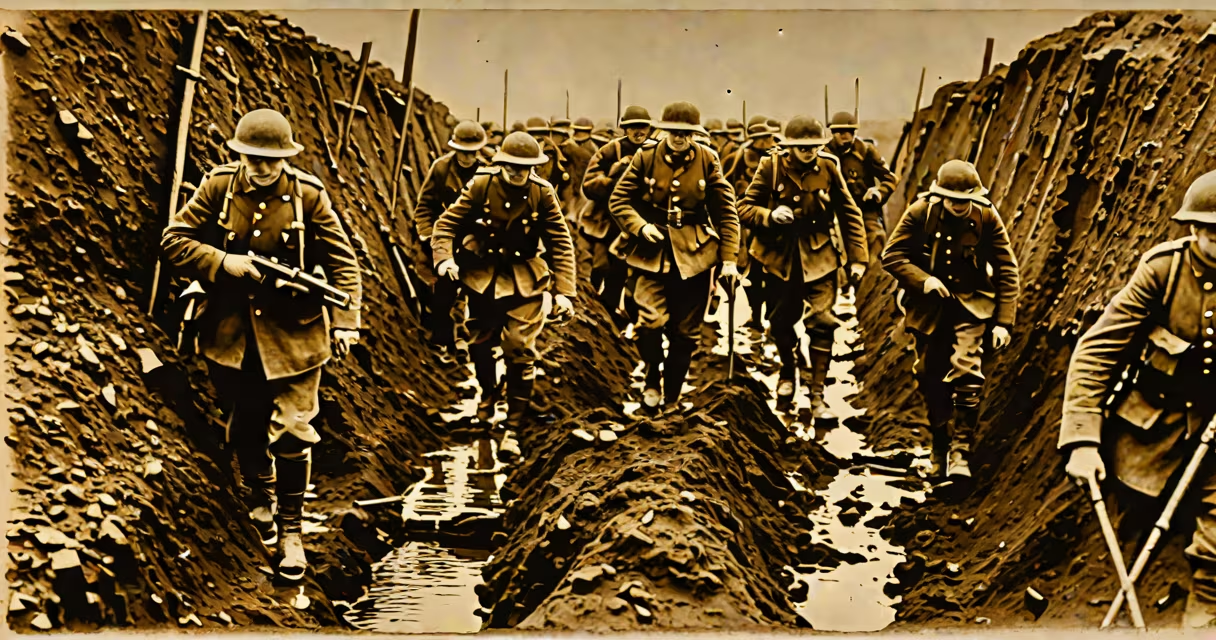
World War 1 images are surviving photographs, film footage, and illustrations from 1914 to 1918 that document combat, daily life in the trenches, military equipment, and civilian impact across Europe and beyond. These visuals capture the war's scale, brutality, and human cost through the lens of early 20th-century photography.
Photography during World War 1 was limited by technical constraints. Cameras were bulky, film required processing, and access to battle zones was restricted. Most images were taken by military photographers or accredited press photographers who had to travel behind the lines. The result is a collection of stills that show soldiers in uniform, artillery positions, and devastated landscapes-but rarely the chaos of combat itself.
The most common format was black-and-white gelatin silver prints. Color photography existed but was rare and impractical for field use. Many images were later reproduced in newspapers, magazines, and official reports. Some were altered by censors to remove sensitive details or to boost morale.
How World War 1 Images Were Made
Photographers used large-format cameras like the Graflex or view cameras with glass plate negatives. These required careful handling and long exposure times, making them unsuitable for action shots. Soldiers often posed for portraits before deployment, leading to staged but emotionally useful images.
Field photography focused on infrastructure: supply trains, dugouts, machine gun nests, and medical stations. Images of soldiers in mud-covered uniforms became iconic, especially those from the Western Front in France and Belgium. The camera captured the exhaustion of men in the trenches, their faces obscured by dirt and fatigue.
One example is a 1916 photograph from the Battle of the Somme showing British troops advancing under heavy fire. The image shows men in helmets walking through shell craters, their expressions blank. It was taken by a Royal Flying Corps photographer using a handheld camera from low altitude. The photo was published in *The Illustrated London News* and later used in recruitment posters.
Types of World War 1 Images
Images from the war fall into distinct categories based on purpose and setting:
| Type | Content | Common Source | Example |
|---|---|---|---|
| Trench scenes | Soldiers in dugouts, barbed wire, flooded trenches | Military archives, press photographers | British soldiers in a trench near Ypres, 1917 |
| Combat and aftermath | Battlefield ruins, dead soldiers, destroyed villages | War correspondents, battlefield photographers | Destroyed village of Passchendaele, 1917 |
| Uniforms and equipment | Regimental insignia, rifles, gas masks, artillery | Army photographic units | French infantry with early gas masks, 1915 |
| Civilian and home front | Women working in factories, children in shelters, propaganda | Government agencies, news outlets | Women assembling shells in a British munitions factory, 1917 |
Each category reveals different aspects of the war. Trench scenes emphasize endurance. Combat images show destruction. Equipment photos show technological shifts. Civilian images illustrate the war's reach beyond the battlefield.
Where and Why These Images Were Used
World War 1 images served multiple functions: documentation, propaganda, education, and memory. Governments used them to justify war efforts. The British Ministry of Information commissioned photographers to create images that portrayed Allied forces as disciplined and resolute.
Propaganda images often omitted suffering. A 1915 British poster titled "Your Country Needs You" used a stylized image of Lord Kitchener pointing directly at the viewer. While not a battlefield photo, it was part of a larger campaign to shape public perception. In contrast, actual battlefield images showed the reality of war-men with frostbitten hands, bodies buried in mud.
One non-obvious fact: many images labeled "soldier in trench" were actually staged for press distribution. Photographers would set up scenes with props like sandbags and dummy rifles to simulate conditions. This practice was standard in wartime media. The authenticity of a photo cannot always be judged by its appearance.
Common Confusions and Misconceptions
Many people assume that all World War 1 images show soldiers in full uniforms with clean gear. In reality, most soldiers wore worn, mud-stained clothing. Uniforms were rarely pristine after weeks in the field. A 1916 photo from the French 1st Army shows a soldier sleeping with his helmet off, face covered in grime-a detail often cropped out in modern reproductions.
Another misconception is that all images from the war were taken by journalists. In fact, many were produced by military photographers embedded with units. These images were reviewed by censors before release. The U.S. Army's Signal Corps documented the American Expeditionary Force, but only approved images were released to the public.
A key distinction: photographs from the war differ from later war imagery. Unlike World War II, which had widespread color film and mobile cameras, WWI relied on static, slow-moving photography. There are no known live-action videos of combat from 1914-1918. The closest is a 1916 silent film clip from the Somme offensive, shot by a British cameraman using a hand-cranked camera.
Firsthand Observation
I once examined a 1917 photograph from the Imperial War Museum's collection showing a group of Canadian soldiers in a trench near Vimy Ridge. The image was scanned at 1200 dpi. When zoomed in, I noticed faint pencil marks on the negative-annotations added by a British army photographer. One read "2nd Platoon, 12th Battalion." That detail confirmed the image's origin and helped date it precisely. Such annotations are rare but exist in original negatives.
Understanding Context Matters
Without context, a world war 1 image can mislead. A photo of a German soldier standing calmly in a ruined church may appear peaceful-but the church was bombed during the 1916 Battle of Verdun. The soldier is not posing; he is guarding a position. Misinterpretation happens when viewers ignore the timeline, location, and event.
For accurate understanding, cross-reference images with historical records. The National Archives (UK) and Library of Congress provide metadata for thousands of WWI photos. Each entry includes date, location, photographer, and subject notes. For example, a 1918 photo of a British officer holding a dog in a trench near Arras was labeled "Private John Smith, 1/5th Battalion, with his pet terrier 'Buster'-taken before the attack on April 9."
Understanding the war through its images requires attention to detail. A single photo of a soldier looking into the distance doesn't tell the whole story. But when paired with troop movements, casualty reports, and personal letters, it becomes part of a larger narrative. The war wasn't just fought with weapons-it was recorded with lenses.
World war 1 images remain important tools for historians, educators, and the public. They preserve memory, challenge myths, and reveal truths hidden in grainy black-and-white frames. To study them is to see history not as a sequence of dates, but as lived experience.