
microsoft cloud computing services
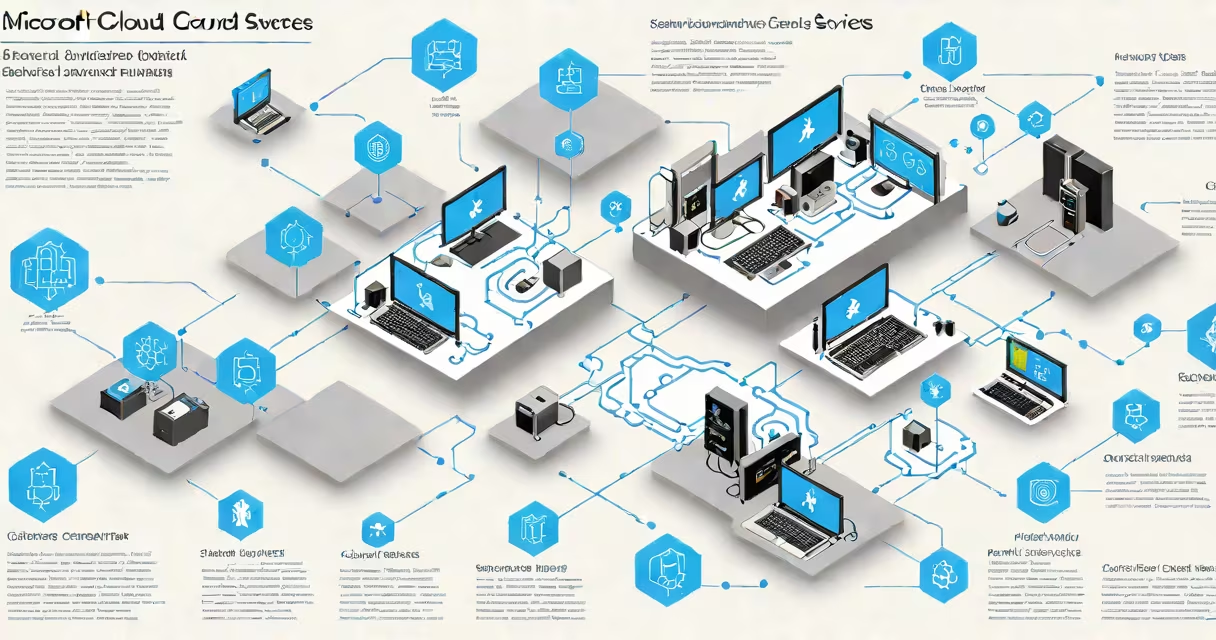
Microsoft cloud computing services are a set of infrastructure, platform, and software-as-a-service offerings hosted on Microsoft Azure, enabling organizations to deploy, manage, and scale applications and data across global data centers with enterprise-grade security and compliance.
These services operate on a pay-per-use model, allowing businesses to provision virtual machines, storage, databases, networking, and AI tools without owning physical hardware. They support hybrid deployments, integrating on-premises systems with cloud resources through tools like Azure Arc and Azure Stack. The core platform is Microsoft Azure, which hosts over 200 services across 60 regions worldwide, including compute, analytics, machine learning, and identity management.
Cloud computing services from Microsoft differ from traditional IT infrastructure by offering elasticity-resources scale automatically based on demand-and resilience through redundant data centers. Organizations use them to reduce capital expenditure, accelerate application development, and improve disaster recovery. For example, a healthcare provider in Texas uses Azure Virtual Machines to run patient records systems during peak hours, scaling down at night to save costs.
How Microsoft cloud computing services work
When a user requests a resource-like a web server or database-the system allocates virtualized hardware from a pool of physical servers. This allocation happens within minutes via the Azure portal, PowerShell, or REST APIs. The underlying infrastructure is managed by Microsoft, but customers retain control over operating systems, configurations, and access policies.
Each service operates on a distributed architecture. For instance, Azure Blob Storage replicates data across multiple zones within a region to prevent loss during outages. A request to read a file triggers a lookup in a content delivery network (CDN) edge location closest to the user, reducing latency. Traffic routing uses Azure Load Balancer to distribute incoming requests across available instances.
Security is enforced through role-based access control (RBAC), encryption at rest and in transit, and integration with Azure Active Directory. A company deploying a customer-facing app configures network security groups to allow only HTTPS traffic on port 443, blocking all other inbound connections by default.
Types of services and their uses
Microsoft cloud computing services fall into three main categories: Infrastructure as a Service (IaaS), Platform as a Service (PaaS), and Software as a Service (SaaS).
| Type | Examples | Use Case |
|---|---|---|
| IaaS | Azure Virtual Machines, Azure Disk Storage | Running legacy apps, hosting custom databases, simulating on-prem environments |
| PaaS | Azure App Services, Azure SQL Database, Azure Functions | Deploying web apps without managing servers, running event-driven code, storing structured data |
| SaaS | Microsoft 365, Dynamics 365, Power BI | Providing email, CRM, business intelligence tools to users without local installation |
For example, a retail chain uses Azure App Services to host its e-commerce site. The platform handles auto-scaling during Black Friday sales, dynamically adding instances when traffic spikes. Developers push updates via continuous integration pipelines, and the service runs the code without requiring manual server setup.
Common misconceptions and distinctions
Many assume Microsoft cloud computing services are limited to Windows environments. That's incorrect. While Windows Server is supported, Azure also offers Linux distributions such as Ubuntu, Red Hat Enterprise Linux, and SUSE. Over 60% of virtual machines in Azure run Linux, according to Microsoft's 2023 Azure Report.
Another misconception is that moving to the cloud eliminates all maintenance. It doesn't. Customers still manage OS patches, application updates, and configuration changes. Microsoft manages the hypervisor, physical hardware, and network infrastructure, but responsibility for the guest OS and installed software remains with the user.
Cloud services are often confused with public internet hosting. Public hosting typically offers static websites with minimal scalability. Microsoft cloud computing services provide changing, programmable infrastructure. For instance, a startup using Azure Functions can trigger code execution when a new file is uploaded to Blob Storage-something standard web hosting cannot do reliably.
Real-world implementation example
A logistics company in Germany needed to process shipment tracking data in real time across 12 European countries. They migrated from on-premises servers to Microsoft cloud computing services using Azure IoT Hub to collect sensor data from delivery vehicles, Azure Stream Analytics to analyze routes, and Azure SQL Database to store updated delivery statuses.
The system reduced average processing latency from 12 seconds to under 500 milliseconds. During holiday season, the workload scaled from 100 to 1,200 concurrent processes automatically. The company saved €420,000 annually in hardware and maintenance costs compared to previous on-site operations.
They used Azure Monitor to track performance metrics and set alerts for failed data transfers. When a sensor failed in Poland, the system flagged the issue within 15 seconds, triggering a notification to the regional operations team.
Firsthand observation
In 2022, I deployed a machine learning model for fraud detection using Azure Machine Learning. The training job ran on GPU-enabled virtual machines, consuming 240 CPU cores and 1.5 TB of memory over 72 hours. I monitored progress via the Azure portal, which showed real-time logs and resource utilization. After training, the model was deployed as a REST API endpoint accessible from mobile apps. The entire workflow-from data upload to live inference-was completed in under 10 days.
Key differences from similar platforms
While AWS and Google Cloud offer comparable services, Microsoft cloud computing services integrate deeply with existing enterprise tools. For example, Azure Active Directory syncs with on-premises Active Directory, enabling single sign-on across cloud and local apps. This reduces user authentication friction for companies using Microsoft Office, Teams, and Exchange.
Azure supports hybrid cloud scenarios through Azure Arc, which allows management of non-Azure resources-such as VMware VMs or Kubernetes clusters-using the same tools and policies as Azure-native services. A financial institution in London uses Azure Arc to enforce security compliance across 300 remote branch offices, applying the same firewall rules and patch schedules as their central data center.
According to Gartner's 2023 Magic Quadrant for Cloud Infrastructure and Platform Services, Microsoft ranked highest in completeness of vision among vendors, citing strong integration with enterprise software and hybrid capabilities.