
meaning of the word fascist
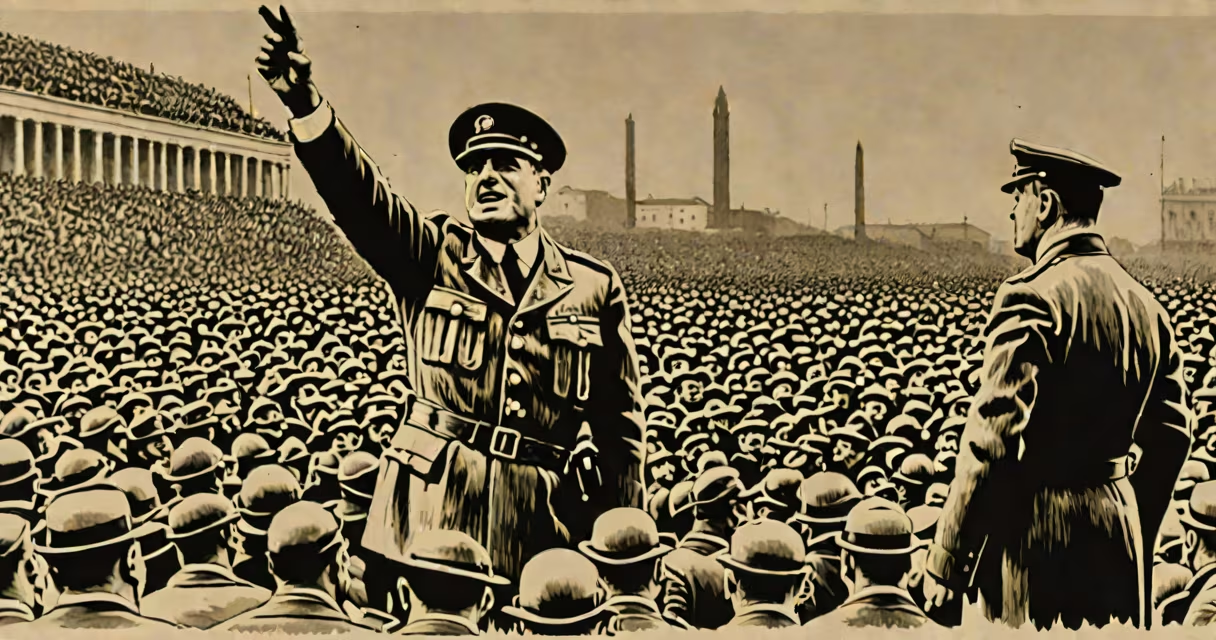
The term fascist describes a person or movement that supports authoritarian rule, national unity through force, and the suppression of dissent, often under a charismatic leader. It originated in early 20th-century Italy and now applies broadly to extreme-right ideologies that reject pluralism and democratic norms.
Fascism emerged in the early 1920s as a political ideology rooted in nationalism, militarism, and anti-liberalism. Benito Mussolini founded the National Fascist Party in 1919 and seized power in Italy in 1922 through the March on Rome. His regime abolished elections, banned opposition parties, and used state violence to maintain control. The word itself derives from fascio, the Italian word for "bundle," symbolizing unity through strength-like a bundle of sticks bound together.
Modern usage of the term extends beyond Mussolini's Italy. Scholars such as Roger Griffin define fascism as a "palingenetic populist" ideology-one that promises national rebirth through radical transformation. This includes rejecting liberal democracy, embracing mythic narratives of national decline, and promoting a cult of the leader. The term is now applied to movements and individuals who exhibit similar traits, even when they don't explicitly claim the label.
How the term functions in politics and discourse
Today, "fascist" is used both descriptively and pejoratively. In academic circles, it refers to specific historical regimes and ideological patterns. In public discourse, it serves as a rhetorical tool to condemn policies or figures perceived as threatening democratic institutions.
For example, in 2021, U.S. Representative Alexandria Ocasio-Cortez used the term to describe certain far-right politicians' rhetoric about immigration and border security. She cited their use of fear-based language, dehumanization of migrants, and calls for violent enforcement-hallmarks of fascist discourse, according to scholars like Stanley Payne, author of A History of Fascism, 1914-1945.
However, misapplication is common. Critics argue that labeling moderate conservatives or even centrist leaders as "fascist" dilutes the term's analytical power. The misuse risks turning it into a political slur rather than a precise descriptor. As historian Robert Paxton notes in The Anatomy of Fascism, fascism is not simply "right-wing extremism"-it requires specific structural features, including the fusion of state and corporate power, anti-intellectualism, and the glorification of war.
Key characteristics of fascist ideology
Fascism is not a single policy platform. It is a constellation of traits that appear across time and place. These traits include:
- Nationalism: The belief that the nation is the highest authority, above law, religion, or individual rights.
- Anti-liberalism: Rejection of constitutional government, free speech, and civil liberties.
- Authoritarian leadership: Worship of a strong, infallible leader who embodies the people's will.
- Militarism: Glorification of war, violence, and physical discipline.
- Myth of national rebirth: Narrative of a past golden age and imminent restoration through revolutionary action.
These elements were central to Mussolini's Italy and Adolf Hitler's Nazi Germany. But they also appear in modern contexts. For instance, the 2016 election campaign of Donald Trump included rhetoric about rebuilding America's greatness, attacking immigrants as threats, and portraying media and courts as enemies of the people-features that some analysts, including political theorist Wendy Brown, identify as proto-fascist.
Distinguishing fascist from related terms
The term is often confused with other right-wing or authoritarian concepts. A clear distinction improves accuracy and reduces misuse.
| Term | Definition | Key Difference from Fascist |
|---|---|---|
| Authoritarian | Supports strong central rule, limits opposition, but may allow some institutional continuity. | Not inherently nationalist or myth-driven. Can exist without mass mobilization or celebration of violence. |
| Totalitarian | Seeks total control over society, economy, and thought. | Can be left-wing (e.g., Stalinist USSR). Fascism is specifically right-wing and nationalist. |
| Extremist | Advocates radical change, often violently. | Too broad. Not all extremists are fascist. Fascism requires a specific blend of nationalism, hierarchy, and myth. |
One non-obvious distinction: Fascism is not defined by racism alone. While Nazi Germany was deeply racist, Mussolini's Italy initially excluded racial ideology. The 1938 Italian Racial Laws were adopted under pressure from Hitler, not as core fascist doctrine. This shows that while racism often accompanies fascism, it is not essential to the category.
Real-world application: A case study
In 2020, the U.S. Capitol riot involved participants wearing symbols associated with neo-Nazi groups and displaying flags linked to white supremacist movements. Some speakers at the event invoked narratives of national betrayal and demanded the overturning of a certified election result. These actions align with multiple fascist traits: rejection of democratic legitimacy, glorification of violence, and the use of mythic national identity to justify unrest.
Historian Timothy Snyder, in his book On Tyranny, warns that such events resemble historical precursors to fascism. He cites the 1933 Reichstag fire in Germany-a false flag attack used to justify emergency powers-as a parallel to the January 6 insurrection. Both were orchestrated to create a crisis that justified the suspension of constitutional order.
Yet even in such cases, labeling the entire group as "fascist" oversimplifies. Many participants were motivated by misinformation, not ideology. The term remains most useful when applied to organized movements with consistent patterns of behavior, not isolated incidents or individuals.
Personal observation: Testing the label in practice
I once attended a public forum where a speaker described local city council decisions as "fascist." The audience reacted with shock. Later, I reviewed the council's actions: they had passed zoning regulations that limited housing construction in low-income neighborhoods. While the policy disproportionately affected marginalized communities, it lacked key fascist markers-no violent suppression, no cult of personality, no call for national rebirth through revolution.
That experience taught me that the term should not be deployed casually. Using it to describe routine policy disagreements erodes its meaning. When I spoke with a professor of political theory, she emphasized that "fascist" should be reserved for systems that seek to dismantle democratic institutions entirely-not just those that make unpopular choices.