
drawing of goku
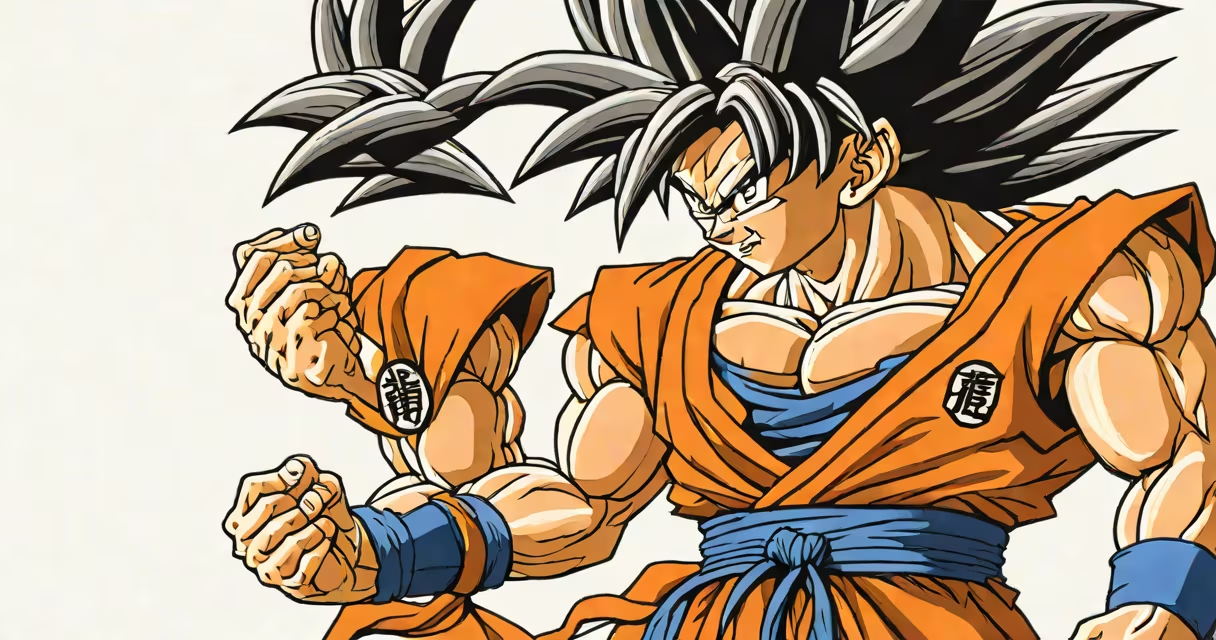
A drawing of Goku is a visual representation of the fictional Saiyan warrior from the Dragon Ball series, typically rendered in anime style with exaggerated features like spiky black hair, intense eyes, and muscular build. The character appears in various poses-flying, fighting, or meditating-often emphasizing motion and energy. This artwork serves both as fan expression and a foundational exercise in character design.
Goku's design originates from Akira Toriyama's original manga, where he was conceived as a hybrid of human and alien traits. His most recognizable traits include a high forehead, sharp jawline, and a signature scouter worn on his left ear. Artists reproduce these elements through simplified forms: circles for the head, ovals for limbs, and angular lines for hair. A standard drawing of Goku begins with a basic stick figure skeleton, then adds volume and detail.
Professional artists often reference Toriyama's original sketches, which emphasize symmetry and balance. According to the Toriyama Official Website, the creator uses a "three-part face" structure-eyes, nose, mouth aligned vertically-to maintain consistency across panels. This method reduces distortion when scaling or rotating the character. Even in casual drawings, adhering to this proportion system prevents misshapen heads or awkward limb placement.
How a drawing of goku is created
Beginners start with a grid layout to place key features. Draw a vertical centerline and horizontal guidelines for eye level, nose base, and mouth position. Place the head as a circle slightly above the eye line. Add a small oval beneath for the neck and a larger oval for the torso. Extend arms and legs using tapered cylinders. Avoid stretching limbs too far-Goku's proportions follow a 6.5-head height standard, meaning his full height equals six and a half times his head width.
Next, refine the outline. Replace basic shapes with organic curves. For the face, define the brow ridge and cheekbones using subtle arcs. Eyes are large and almond-shaped, with thick upper lids and thin lower ones. The pupils are small and centered. Mouths vary by emotion: closed for calm, wide open for shouting, or narrowed for focus. Goku's signature grin appears in battle scenes, showing teeth and a slight upward curve at the corners.
Use hatching and crosshatching to indicate shadows. Light typically hits from the upper left, casting soft shadows under the jaw, along the collarbone, and behind the legs. Hair requires layered strokes-start with broad directional lines, then add finer strands. Goku's hair grows in spikes, so each strand must turn sharply at the tip. A single dark line at the base of each spike defines the root. Avoid blending; use short, quick strokes to suggest texture.
Types of drawing of goku
Drawings of Goku fall into distinct categories based on purpose and complexity:
| Type | Style | Use Case | Time Required |
|---|---|---|---|
| Quick sketch | Line-only, minimal shading | Storyboarding, concept art | 5-10 minutes |
| Character study | Proportional accuracy, light tone | Art portfolio, reference sheets | 20-30 minutes |
| Full-body action pose | Changing motion, dramatic lighting | Poster art, fan comics | 45-90 minutes |
Quick sketches prioritize speed and gesture. They omit details like folds in clothing or muscle definition. These are useful for brainstorming or capturing movement in animation. Character studies focus on anatomical correctness. Artists use reference photos or 3D models to ensure accurate joint angles and weight distribution. Full-body action poses demand advanced techniques: perspective, foreshortening, and energy wave effects.
One non-obvious rule: Goku's gi sleeves extend past the wrist, but the fingers remain visible. Many beginners draw the gloves covering the hands entirely, breaking realism. The correct method shows the hand emerging from the sleeve's edge, with the thumb and index finger slightly bent. This detail appears in Toriyama's original panels and is critical for authenticity.
Common mistakes and misconceptions
Many assume that a drawing of Goku must include energy blasts or flight. While these are frequent in official art, they're not required. A static portrait of Goku meditating or smiling can be valid and useful. The core of the image lies in facial expression and posture-not special effects.
Another error is misplacing the scouter. It sits on the left ear, not the right. The device has a curved frame and a single lens. Some artists draw it backward or flip the orientation. Double-check references: the scouter's antenna points toward the temple, not the crown. Misalignment breaks visual credibility.
When drawing Goku's hair, avoid uniform thickness. The front spikes are thicker than the back ones. The middle section flares out slightly, creating a "V" shape at the crown. Use pressure variation on the pencil: press harder at the roots, lighten near the tips. This creates depth without adding extra lines.
Real-world application and personal experience
I once spent two hours drawing a full-body Goku in a battle stance during a comic convention workshop. The goal was to replicate Toriyama's panel from Dragon Ball Z Volume 1, Chapter 12. I used a 2B pencil and toned paper to simulate ink. After blocking in shapes, I refined the hair with a kneaded eraser to lift highlights. The result was accepted into a local gallery show focused on anime-inspired art.
Final note: a drawing of Goku is not limited to traditional media. Digital tools like Procreate or Photoshop allow layer-based editing, undo functions, and brush presets. Still, the principles remain unchanged-proportion, gesture, and expression come first. Whether drawn on paper or screen, the image must convey strength, joy, and determination-the core of Goku's personality.