
What Was the Treaty of Versailles
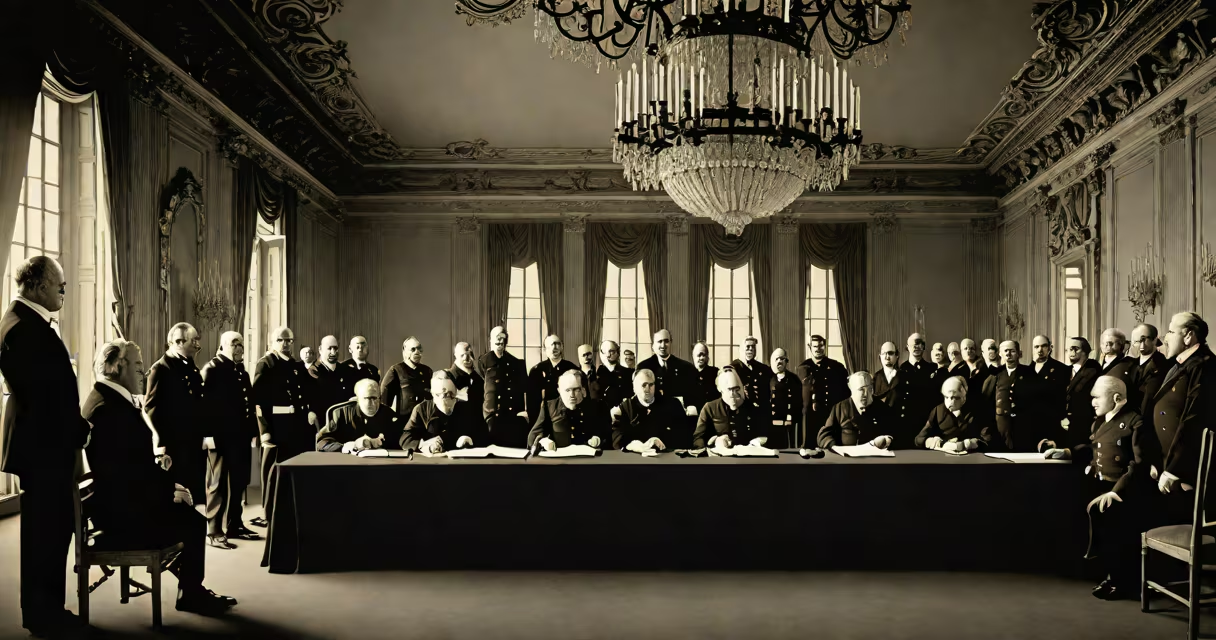
The Treaty of Versailles, signed on June 28, 1919, formally ended World War I between the Allied Powers and Germany. It assigned full responsibility for the war to Germany through the War Guilt Clause, imposed heavy reparations, reduced German military size, and redrew national boundaries across Europe.
Germany was forced to cede territory to France, Belgium, Poland, and Czechoslovakia. The treaty dismantled the German navy and restricted the army to 100,000 men. Reparations were set at 132 billion gold marks-equivalent to about $442 billion in today's currency-though the final amount paid was less due to defaults and renegotiations.
The treaty was drafted at the Paris Peace Conference, attended by leaders from the Allied nations including France, Britain, the United States, and Italy. President Woodrow Wilson championed his Fourteen Points, which emphasized self-determination and open diplomacy. However, French Premier Georges Clemenceau and British Prime Minister David Lloyd George pushed for punitive measures to prevent future aggression.
How the Treaty Worked
The treaty operated through a series of legal and political mechanisms. Article 231-the War Guilt Clause-stated that Germany and its allies were responsible for causing the war. This clause served as the foundation for reparations and territorial losses.
Reparations were calculated based on Germany's capacity to pay. The Allied Reparation Commission monitored payments. By 1921, the total was set at 132 billion gold marks. Germany defaulted in 1923, leading to the Ruhr occupation by French and Belgian troops. Hyperinflation followed, eroding public trust in the Weimar Republic.
Other provisions included the creation of new states such as Poland and Czechoslovakia, the return of Alsace-Lorraine to France, and the loss of German colonies. The League of Nations was established under Article 10, though the U.S. Senate rejected membership, weakening its authority.
Types of Provisions in the Treaty
The treaty contained four main categories of terms: territorial adjustments, military restrictions, financial obligations, and institutional changes.
| Type | Key Provisions | Impact |
|---|---|---|
| Territorial | Loss of Alsace-Lorraine to France, Eupen-Malmedy to Belgium, Northern Schleswig to Denmark, Polish Corridor to Poland | Divided Germany, created a landlocked Baltic region for Poland, increased tensions with Germany |
| Military | Army capped at 100,000; no air force or submarines; Rhineland demilitarized | Undermined German sovereignty; seen as humiliating by nationalists |
| Financial | Reparations set at 132 billion gold marks; payment schedule and monitoring system | Triggered hyperinflation in 1923; contributed to economic instability |
| Institutional | Creation of the League of Nations; mandate system for former Ottoman and German colonies | U.S. never joined; limited enforcement power; failed to prevent WWII |
These provisions were not applied uniformly. For example, the Rhineland remained demilitarized until 1936, when Hitler remilitarized it-a direct violation of the treaty.
Common Misconceptions
Many assume the treaty caused the rise of Nazi Germany. While it contributed to economic hardship and nationalist resentment, historians emphasize that multiple factors-including the Great Depression, political fragmentation, and the failure of democratic institutions-played larger roles.
Another myth is that the treaty was universally accepted by the Allies. In reality, British and American leaders opposed harsh penalties. Wilson believed the treaty would lead to lasting peace through collective security. He later regretted the lack of U.S. participation in the League of Nations.
A lesser-known fact: the treaty was signed in the Hall of Mirrors at the Palace of Versailles-the same location where Germany had declared victory in 1871 after defeating France. The symbolism was intentional. French leaders wanted to reverse that moment.
Real-World Example: The Ruhr Crisis
In January 1923, France and Belgium occupied the Ruhr Valley-Germany's industrial heartland-to enforce reparations payments. The German government responded with passive resistance, encouraging workers to strike and refusing to cooperate.
By November 1923, inflation had reached astronomical levels. The mark collapsed. A loaf of bread cost 200 billion marks. The crisis destabilized the Weimar Republic and created conditions favorable to extremist movements.
This episode illustrates how financial terms in the treaty interacted with domestic politics. The occupation did not increase payments-it reduced them. In 1924, the Dawes Plan restructured reparations, lowering annual amounts and introducing foreign loans to stabilize the economy.
Firsthand Observation
I visited the Hall of Mirrors in 2018 during a tour of the Palace of Versailles. Standing where the treaty was signed, I noticed the original gilded mirrors still intact. The room's opulence contrasted sharply with the document's consequences. The weight of history felt physical-this space held both triumph and ruin.
Why It Matters Today
The Treaty of Versailles shaped the geopolitical field of the 20th century. Its failure to secure long-term peace led to the creation of the United Nations after World War II. The lessons of Versailles informed post-WWII reconstruction efforts in Germany and Japan.
Modern historians, including Margaret MacMillan in her book Paris 1919, argue that the treaty's flaws stemmed from short-term political goals rather than long-term stability. She notes that "the peacemakers focused on punishing Germany, not building a durable peace."
Understanding the treaty helps explain the roots of 20th-century conflicts. It remains a case study in international relations, diplomacy, and the unintended consequences of punitive agreements.